 Corporate Information & Media Room

Country or Region selection
Worldwide MSC International
Europe
Corporate Information & Media Room
MSC Foundation and Perry Institute for Marine Science Strengthen Coral Science Collaboration in The Bahamas
23/03/2026- New coral species expand Ocean Cay nursery diversity and resilience
- Partnership advances reef preservation across the greater Bahamas
The MSC Foundation and the Perry Institute for Marine Science (PIMS) have strengthened their long-standing partnership to protect and restore some of the Caribbean’s most threatened reef-building corals.
Last month, senior marine scientists and coral specialists from PIMS travelled to Ocean Cay to mark a new milestone in collaboration: an exchange of coral to increase nursery diversity, strengthen genetic resilience and support reef recovery across The Bahamas.
During the visit, PIMS scientists Alex Frans (Coral Program Manager, Bahamas), Anwar Godet (Marine & Field Operations Specialist) and Gimel Morley (Coral Aquarist Manager) worked alongside Emeline Bouchet, MSC Foundation Marine Programme Manager, to carry out the expansion.
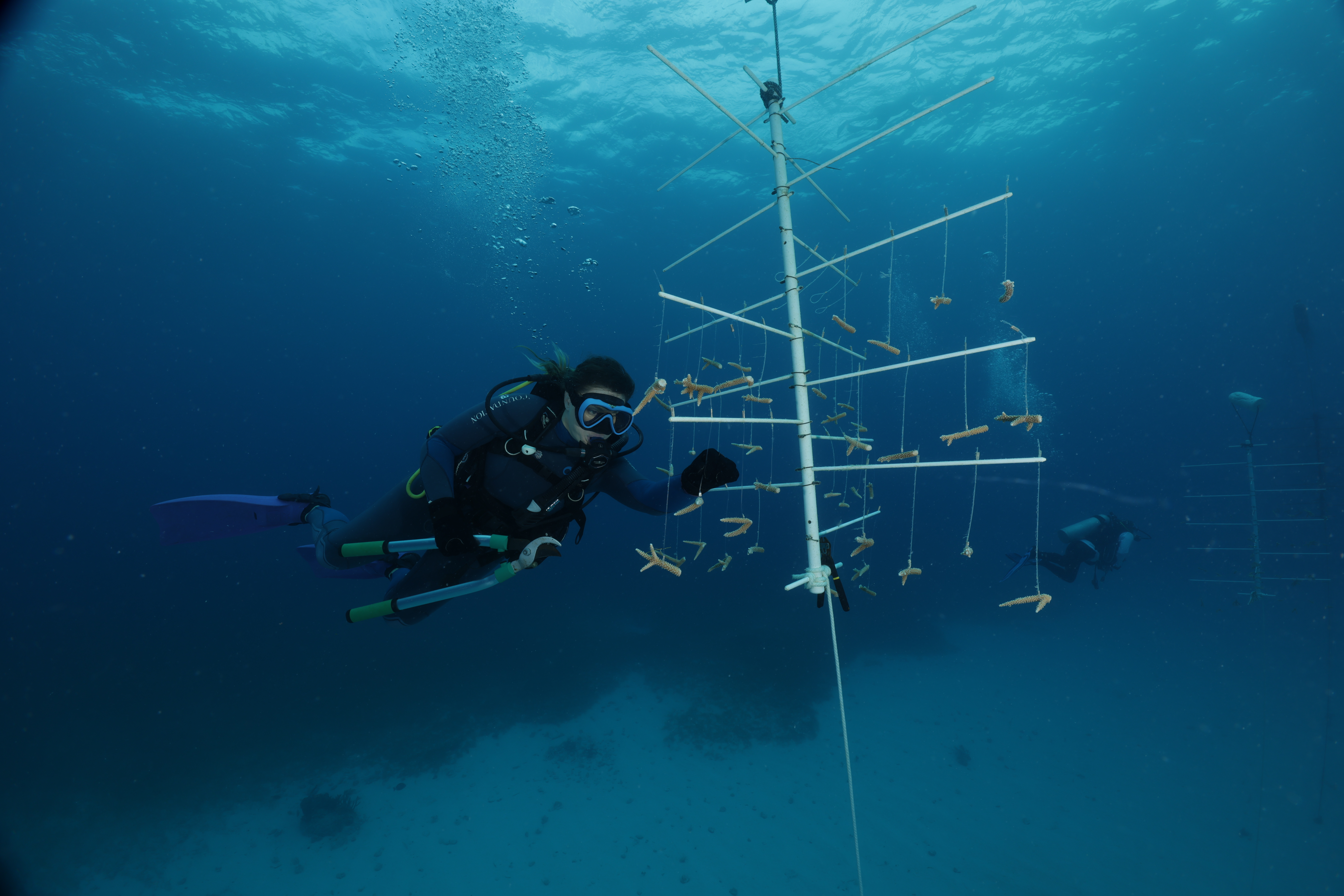
In line with the permit granted by the Department of Environmental Planning and Protection (DEPP), PIMS transported 100 fragments of staghorn coral (Acropora cervicornis) and 150 fragments of fused staghorn coral (Acropora prolifera) to Ocean Cay in specially designed, temperature-controlled containers to ensure safe transfer. The fragments were installed on the MSC Foundation’s offshore nursery coral trees, expanding the number of species under cultivation and increasing the size of the nursery to 637 fragments.
PIMS also incorporated fragments of elkhorn coral (Acropora palmata) into the nurseries they manage under the Reef Rescue Network, increasing the genetic diversity of restoration stock and contributing to the Bahamas Coral Gene Bank, a partnership with the government of The Bahamas to safeguard the country's coral genetic resources. The Reef Rescue Network is PIMS' coral restoration program, uniting businesses, dive shops, and non-profits to restore coral reefs across the Caribbean through nursery development, maintenance, and outplanting.
Elkhorn coral is classified as Critically Endangered on the IUCN Red List of Threatened Species. In The Bahamas, the remaining populations are extremely limited. The MSC Foundation’s nursery at Ocean Cay holds some of the only fragments of this species currently under active cultivation in the country, making its protection and propagation particularly significant for Bahamian marine biodiversity.
By growing the pool of critically endangered reef-building corals across multiple nursery sites, the partnership strengthens national restoration capacity and contributes to the long-term resilience of reefs throughout the region.
CORAL REEF RESTORATION: KEY FACTS
Growing corals in nurseries
Coral restoration begins by carefully collecting small fragments from healthy parent colonies. These fragments are grown in underwater nurseries, often suspended on structures known as coral trees. In these controlled marine environments, corals benefit from optimal light, water flow and regular monitoring, allowing them to grow faster and more safely than on degraded reefs.
Outplanting to rebuild reef structure
Once nursery corals reach sufficient size, they are “outplanted” onto carefully selected reef sites. Secured to stable substrate, they continue growing and gradually restore the complex three-dimensional structure that supports fish, invertebrates and countless other marine species.
Species such as elkhorn coral (Acropora palmata) and staghorn coral (Acropora cervicornis) are especially important because they are fast-growing, reef-building corals. Their branching structures form the architectural foundation of Caribbean reefs. However, decades of disease, bleaching, storm damage and coastal pressures have reduced their populations by more than 80 per cent in some regions, leading to their Critically Endangered classification.
Maintaining genetic diversity within nurseries is essential. A broader pool of coral genotypes improves resilience to warming seas, disease and extreme weather, increasing the likelihood that restored reefs will survive in a changing climate.
Building on a Shared History
PIMS has been involved in the MSC Foundation’s coral work from the outset. In 2019, PIMS scientists were among the first local marine conservation experts to conduct baseline reef assessments that informed the design of the Foundation’s programme. Their scientific guidance helped shape site selection, nursery development and long-term monitoring protocols.
The nursery expansion this February marks a further step in scaling restoration efforts through collaboration.
"This work is about building long-term resilience for Bahamian reefs,” said Dr. Aaron Hartmann, Senior Scientist at the helm of PIMS’ coral program in The Bahamas. “By growing the diversity of corals across our nursery network, we are strengthening the foundation for reef recovery throughout The Bahamas and we are contributing to a national effort to safeguard these critically endangered species for future generations."
Emeline Bouchet, Marine Programme Manager at the MSC Foundation, added: “Our nursery at Ocean Cay now safeguards one of the most important remaining pools of elkhorn coral in The Bahamas. By expanding the number of species we cultivate and deepening our collaboration with PIMS, we are reinforcing a rigorous scientific approach while contributing to the protection of critically endangered corals for the greater good of Bahamian marine biodiversity.”
Healthy coral reefs protect coastlines, sustain fisheries, support tourism livelihoods and provide habitat for thousands of species. Through this strengthened partnership, the MSC Foundation and PIMS are combining scientific expertise and operational capacity to accelerate reef recovery, helping to secure a more resilient future for the reefs of The Bahamas and beyond.
###
ABOUT MSC FOUNDATION
Headquartered in Geneva, Switzerland, the MSC Foundation is the philanthropic arm of the MSC Group. Established in 2018, the Foundation supports initiatives in environmental conservation, community support, education, and emergency relief. Its mission is to use MSC’s global reach and knowledge of the sea to take action that contributes to protecting and nurturing the blue planet and its people.
ABOUT THE MARINE CONSERVATION CENTER
The MSC Foundation’s Marine Conservation Center (MCC), located at Ocean Cay in The Bahamas, is a dedicated hub for coral conservation, marine research, and environmental education. The MCC serves as a base for biologists, scientists, students, and island visitors, offering interactive, real-world learning focused on preserving the marine ecosystem. The facility features a discovery pavilion, a lecture hall, a fully equipped Bio Lab, and a land-based coral nursery. It also serves as the base for the MSC Foundation’s Super Coral Reefs Program, which is dedicated to restoring resilient coral ecosystems.
The MCC provides educational opportunities that raise awareness about the importance of coral reefs and the urgent need to safeguard marine life. Through partnerships with leading institutions such as the University of The Bahamas, the Bahamas Agriculture and Marine Science Institute, and the Perry Institute for Marine Science, the Center helps to equip Bahamian students, researchers, and conservationists with the knowledge and tools needed to protect our oceans.
ABOUT PERRY INSTITUTE FOR MARINE SCIENCE
Founded in 1970, Perry Institute for Marine Science (PIMS) is a leading marine research and conservation organization dedicated to protecting ocean ecosystems in The Bahamas and around the world. PIMS conducts rigorous scientific research on coral reefs, fisheries, and marine biodiversity, and translates that science into practical conservation outcomes. Through its Reef Rescue Network, PIMS manages coral nurseries and restoration sites across the wider Caribbean, working to recover populations of critically endangered reef-building species. PIMS also delivers hands-on marine science education and professional dive training, building the next generation of ocean stewards. For more information, visit perryinstitute.org.
Country or Region selection
Worldwide MSC International
Europe


